


Page 20 - Demo
P. 20
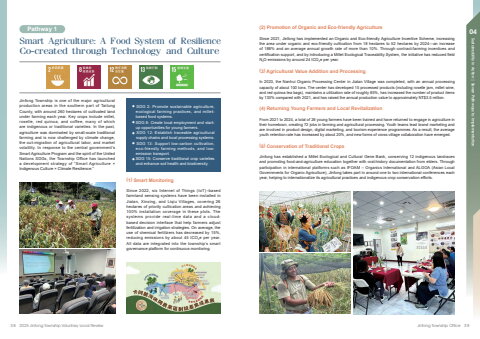
38 2025 Jinfong Township Voluntary Local Review Jinfong Township Office 39Sustainability in Action | Seven Pathways to Implementation04Smart Agriculture: A Food System of ResilienceCo-created through Technology and CultureJinfong Township is one of the major agricultural production areas in the southern part of Taitung County, with around 260 hectares of cultivated land under farming each year. Key crops include millet, roselle, red quinoa, and coffee, many of which are indigenous or traditional varieties. In the past, agriculture was dominated by small-scale traditional farming and is now challenged by climate change, the out-migration of agricultural labor, and market volatility. In response to the central government%u2019s Smart Agriculture Program and the spirit of the United Nations SDGs, the Township Office has launched a development strategy of %u201cSmart Agriculture %u00d7 Indigenous Culture %u00d7 Climate Resilience.%u201dPathway 1(1) Smart MonitoringSince 2022, six Internet of Things (IoT)%u2013based farmland sensing systems have been installed in Jialan, Xinxing, and Liqiu Villages, covering 26 hectares of priority cultivation areas and achieving 100% installation coverage in these plots. The systems provide real-time data and a cloudbased decision interface that help farmers adjust fertilization and irrigation strategies. On average, the use of chemical fertilizers has decreased by 15%, reducing emissions by about 45 tCO2e per year. All data are integrated into the township%u2019s smart governance platform for continuous monitoring.%u25c6 SDG 2: Promote sustainable agriculture, ecological farming practices, and milletbased food systems.%u25c6 SDG 8: Create local employment and startup opportunities for young farmers.%u25c6 SDG 12: Establish traceable agricultural supply chains and local processing systems.%u25c6 SDG 13: Support low-carbon cultivation, eco-friendly farming methods, and lowemission transport.%u25c6 SDG 15: Conserve traditional crop varieties and enhance soil health and biodiversity.(2) Promotion of Organic and Eco-friendly AgricultureSince 2021, Jinfong has implemented an Organic and Eco-friendly Agriculture Incentive Scheme, increasing the area under organic and eco-friendly cultivation from 18 hectares to 52 hectares by 2024%u2014an increase of 188% and an average annual growth rate of more than 10%. Through contract-farming incentives and certification support, and by introducing a Millet Ecological Traceability System, the initiative has reduced field N2O emissions by around 24 tCO2e per year.(3) Agricultural Value Addition and ProcessingIn 2023, the Nanhui Organic Processing Center in Jialan Village was completed, with an annual processing capacity of about 100 tons. The center has developed 15 processed products (including roselle jam, millet wine, and red quinoa tea bags), maintains a utilization rate of roughly 85%, has increased the number of product items by 133% compared with 2021, and has raised the annual production value to approximately NT$3.5 million.(4) Returning Young Farmers and Local RevitalizationFrom 2021 to 2024, a total of 26 young farmers have been trained and have returned to engage in agriculture in their hometown, creating 72 jobs in farming and agricultural processing. Youth teams lead brand marketing and are involved in product design, digital marketing, and tourism experience programmes. As a result, the average youth retention rate has increased by about 20%, and new forms of cross-village collaboration have emerged.(5) Conservation of Traditional CropsJinfong has established a Millet Ecological and Cultural Gene Bank, conserving 12 indigenous landraces and promoting food-and-agriculture education together with oral-history documentation from elders. Through participation in international platforms such as IFOAM %u2013 Organics International and ALGOA (Asian Local Governments for Organic Agriculture), Jinfong takes part in around one to two international conferences each year, helping to internationalize its agricultural practices and indigenous crop conservation efforts.


