


Page 31 - Demo
P. 31
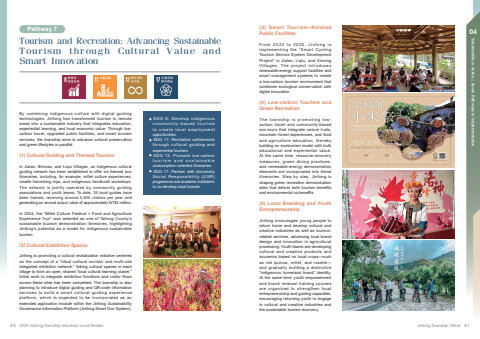
60 2025 Jinfong Township Voluntary Local Review Jinfong Township Office 6 1Sustainability in Action | Seven Pathways to Implementation04Tourism and Recreation: Advancing SustainableTourism through Cultural Value andSmart InnovationBy combining indigenous culture with digital guiding technologies, Jinfong has transformed tourism in remote areas into a sustainable industry that integrates education, experiential learning, and local economic value. Through lowcarbon travel, upgraded public facilities, and smart tourism services, the township aims to advance cultural preservation and green lifestyles in parallel. (1) Cultural Guiding and Themed TourismIn Jialan, Binmao, and Liqiu Villages, an indigenous cultural guiding network has been established to offer six themed tour itineraries, including, for example, millet culture experiences, roselle harvesting trips, and indigenous handicraft workshops. The network is jointly operated by community guiding associations and youth teams. To date, 35 local guides have been trained, receiving around 5,000 visitors per year and generating an annual output value of approximately NT$3 million.In 2024, the %u201cMillet Culture Festival %u00d7 Food and Agriculture Experience Tour%u201d was selected as one of Taitung County%u2019s sustainable tourism demonstration itineraries, highlighting Jinfong%u2019s potential as a model for indigenous sustainable tourism. (2) Cultural Exhibition SpacesJinfong is promoting a cultural revitalization initiative centered on the concept of a %u201ctribal cultural corridor and multi-site integrated exhibition network,%u201d linking cultural spaces in each village to form an open, shared %u201clocal cultural learning cluster.%u201d Initial work to integrate exhibition functions and visitor flows across these sites has been completed. The township is also planning to introduce digital guiding and QR-code information services to build a smart cultural guiding experience platform, which is expected to be incorporated as an extended application module within the Jinfong Sustainability Governance Information Platform (Jinfong Smart Gov System).(3) Smart Tourism%u2013Related Public FacilitiesF r o m 2 0 2 3 t o 2 0 2 5 , J i n f o n g i s implementing the %u201cSmart Cycling Tourism Service System Development Project%u201d in Jialan, Liqiu, and Xinxing Villages. The project introduces renewable-energy support facilities and smart management systems to create a low-carbon tourism environment that combines ecological conservation with digital innovation.(4) Low-carbon Tourism and Green RecreationThe township is promoting lowcarbon travel and community-based eco-tours that integrate nature trails, mountain%u2013forest experiences, and food and agriculture education, thereby building an ecotourism model with both educational and experiential value. At the same time, resource-recovery measures, green dining practices, and renewable-energy demonstration elements are incorporated into these itineraries. Step by step, Jinfong is shaping green recreation demonstration sites that deliver both tourism benefits and environmental co-benefits.(5) Local Branding and Youth EntrepreneurshipJinfong encourages young people to return home and develop cultural and creative industries as well as tourismrelated services, advancing local brand design and innovation in agricultural processing. Youth teams are developing cultural and creative products and souvenirs based on local crops%u2014such as red quinoa, millet, and roselle%u2014and gradually building a distinctive %u201cindigenous homeland brand%u201d identity. At the same time, youth empowerment and brand renewal training courses are organized to strengthen local entrepreneurship and guiding capacities, encouraging returning youth to engage in cultural and creative industries and the sustainable tourism economy.Pathway 7%u25c6 SDG 8: Develop indigenous c o m m u n i t y %u2013 b a s e d t o u r i s m to create local employment opportunities.%u25c6 SDG 11: Revitalize settlements through cultural guiding and experiential tourism.%u25c6 SDG 12: Promote low-carbon t o u r i s m a n d s u s t a i n a b l e consumption%u2013oriented itineraries.%u25c6 SDG 17: Partner with University Social Responsibility (USR) programmes and academic institutions to co-develop local brands.


