


Page 6 - Demo
P. 6
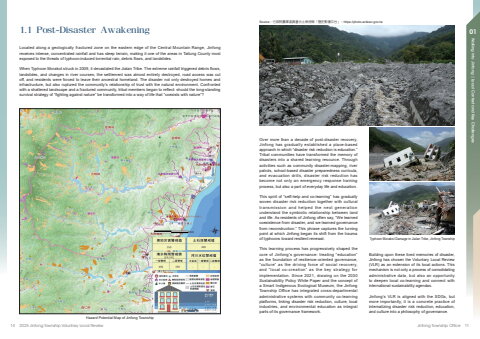
Walking into Jinfong | Local Context and Key Challenges0110 2025 Jinfong Township Voluntary Local Review Jinfong Township Office 1 11.1 Post-Disaster AwakeningLocated along a geologically fractured zone on the eastern edge of the Central Mountain Range, Jinfong receives intense, concentrated rainfall and has steep terrain, making it one of the areas in Taitung County most exposed to the threats of typhoon-induced torrential rain, debris flows, and landslides.When Typhoon Morakot struck in 2009, it devastated the Jialan Tribe. The extreme rainfall triggered debris flows, landslides, and changes in river courses; the settlement was almost entirely destroyed, road access was cut off, and residents were forced to leave their ancestral homeland. The disaster not only destroyed homes and infrastructure, but also ruptured the community%u2019s relationship of trust with the natural environment. Confronted with a shattered landscape and a fractured community, tribal members began to reflect: should the long-standing survival strategy of %u201cfighting against nature%u201d be transformed into a way of life that %u201ccoexists with nature%u201d?Over more than a decade of post-disaster recovery, Jinfong has gradually established a place-based approach in which %u201cdisaster risk reduction is education.%u201d Tribal communities have transformed the memory of disasters into a shared learning resource. Through activities such as community disaster-mapping, river patrols, school-based disaster preparedness curricula, and evacuation drills, disaster risk reduction has become not only an emergency response training process, but also a part of everyday life and education.This spirit of %u201cself-help and co-learning%u201d has gradually woven disaster risk reduction together with cultural transmission and helped the next generation understand the symbiotic relationship between land and life. As residents of Jinfong often say, %u201cWe learned coexistence from disaster, and we learned governance from reconstruction.%u201d This phrase captures the turning point at which Jinfong began its shift from the trauma of typhoons toward resilient renewal.This learning process has progressively shaped the core of Jinfong%u2019s governance: treating %u201ceducation%u201d as the foundation of resilience-oriented governance, %u201cculture%u201d as the driving force of social recovery, and %u201clocal co-creation%u201d as the key strategy for implementation. Since 2021, drawing on the 2030 Sustainability Policy White Paper and the concept of a Smart Indigenous Ecological Museum, the Jinfong Township Office has integrated cross-departmental administrative systems with community co-learning platforms, linking disaster risk reduction, culture, local industries, and environmental education as integral parts of its governance framework.Typhoon Morakot Damage in Jialan Tribe, Jinfong TownshipHazard Potential Map of Jinfong TownshipBuilding upon these lived memories of disaster, Jinfong has chosen the Voluntary Local Review (VLR) as an extension of its local actions. This mechanism is not only a process of consolidating administrative data, but also an opportunity to deepen local co-learning and connect with international sustainability agendas.Jinfong%u2019s VLR is aligned with the SDGs, but more importantly, it is a concrete practice of internalizing disaster risk reduction, education, and culture into a philosophy of governance.Source%uff1a%u884c%u653f%u9662%u8fb2%u696d%u59d4%u54e1%u6703%u6c34%u571f%u4fdd%u6301%u5c40%u300c%u6b77%u53f2%u5f71%u50cf%u5e73%u53f0%u300d%uff0chttps://photo.ardswc.gov.tw


