


Page 9 - Demo
P. 9
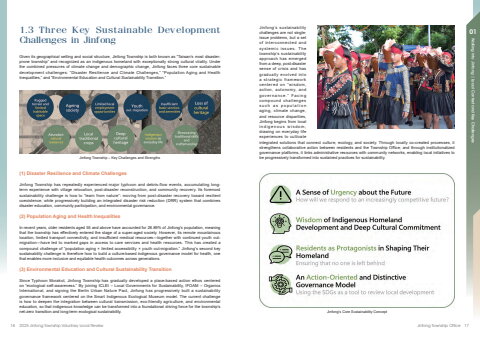
Walking into Jinfong | Local Context and Key Challenges011 6 2025 Jinfong Township Voluntary Local Review Jinfong Township Office 1 71.3 Three Key Sustainable Development Challenges in Jinfong(1) Disaster Resilience and Climate ChallengesJinfong Township has repeatedly experienced major typhoon and debris-flow events, accumulating longterm experience with village relocation, post-disaster reconstruction, and community recovery. Its foremost sustainability challenge is how to %u201clearn from nature%u201d: moving from post-disaster recovery toward resilient coexistence, while progressively building an integrated disaster risk reduction (DRR) system that combines disaster education, community participation, and environmental governance.(2) Population Aging and Health InequalitiesIn recent years, older residents aged 55 and above have accounted for 28.89% of Jinfong%u2019s population, meaning that the township has effectively entered the stage of a super-aged society. However, its remote mountainous location, limited transport connectivity, and insufficient medical resources%u2014together with continued youth outmigration%u2014have led to marked gaps in access to care services and health resources. This has created a compound challenge of %u201cpopulation aging %u00d7 limited accessibility %u00d7 youth out-migration.%u201d Jinfong%u2019s second key sustainability challenge is therefore how to build a culture-based indigenous governance model for health, one that enables more inclusive and equitable health outcomes across generations.(3) Environmental Education and Cultural Sustainability TransitionSince Typhoon Morakot, Jinfong Township has gradually developed a place-based action ethos centered on %u201cecological self-awareness.%u201d By joining ICLEI %u2013 Local Governments for Sustainability, IFOAM %u2013 Organics International, and signing the Berlin Urban Nature Pact, Jinfong has progressively built a sustainability governance framework centered on the Smart Indigenous Ecological Museum model. The current challenge is how to deepen the integration between cultural transmission, eco-friendly agriculture, and environmental education, so that indigenous knowledge can be transformed into a foundational driving force for the township%u2019s net-zero transition and long-term ecological sustainability.Jinfong%u2019s sustainability challenges are not singleissue problems, but a set of interconnected and systemic issues. The township%u2019s sustainability approach has emerged from a deep, post-disaster sense of crisis and has gradually evolved into a strategic framework centered on %u201cwisdom, action, autonomy, and governance.%u201d Facing compound challenges s u c h a s p o p u l a t i o n aging, climate change, and resource disparities, Jinfong begins from local i n d i g e n o u s w i s d o m , drawing on everyday life experiences to cultivate integrated solutions that connect culture, ecology, and society. Through locally co-created processes, it strengthens collaborative action between residents and the Township Office; and through institutionalized governance platforms, it links administrative resources with community networks, enabling local initiatives to be progressively transformed into sustained practices for sustainability.Given its geographical setting and social structure, Jinfong Township is both known as %u201cTaiwan%u2019s most disasterprone township%u201d and recognized as an indigenous homeland with exceptionally strong cultural vitality. Under the combined pressures of climate change and demographic change, Jinfong faces three core sustainable development challenges: %u201cDisaster Resilience and Climate Challenges,%u201d %u201cPopulation Aging and Health Inequalities,%u201d and %u201cEnvironmental Education and Cultural Sustainability Transition.%u201dJinfong%u2019s Core Sustainability ConceptJinfong Township %u2013 Key Challenges and Strengths


