


Page 8 - Demo
P. 8
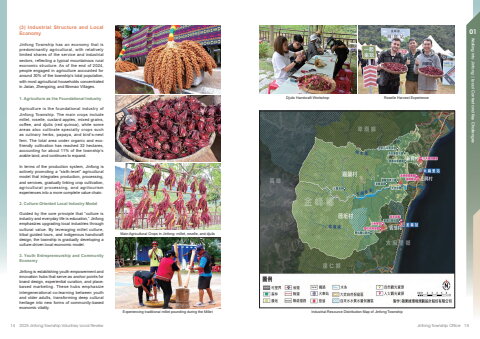
Walking into Jinfong | Local Context and Key Challenges0114 2025 Jinfong Township Voluntary Local Review Jinfong Township Office 15Experiencing traditional millet pounding during the Millet Industrial Resource Distribution Map of Jinfong TownshipRoselle Harvest ExperienceMain Agricultural Crops in Jinfong: millet, roselle, and djulis(3) Industrial Structure and Local EconomyJinfong Township has an economy that is predominantly agricultural, with relatively limited shares of the service and industrial sectors, reflecting a typical mountainous rural economic structure. As of the end of 2024, people engaged in agriculture accounted for around 30% of the township%u2019s total population, with most agricultural households concentrated in Jialan, Zhengxing, and Binmao Villages.1. Agriculture as the Foundational IndustryAgriculture is the foundational industry of Jinfong Township. The main crops include millet, roselle, custard apples, mixed grains, coffee, and djulis (red quinoa), while some areas also cultivate specialty crops such as culinary herbs, papaya, and bird%u2019s-nest fern. The total area under organic and ecofriendly cultivation has reached 32 hectares, accounting for about 11% of the township%u2019s arable land, and continues to expand.In terms of the production system, Jinfong is actively promoting a %u201csixth-level%u201d agricultural model that integrates production, processing, and services, gradually linking crop cultivation, agricultural processing, and agritourism experiences into a more complete value chain.2. Culture-Oriented Local Industry ModelGuided by the core principle that %u201cculture is industry and everyday life is education,%u201d Jinfong emphasizes upgrading local industries through cultural value. By leveraging millet culture, tribal guided tours, and indigenous handicraft design, the township is gradually developing a culture-driven local economic model.3. Youth Entrepreneurship and Community EconomyJinfong is establishing youth empowerment and innovation hubs that serve as anchor points for brand design, experiential curation, and placebased marketing. These hubs emphasize intergenerational co-learning between youth and older adults, transforming deep cultural heritage into new forms of community-based economic vitality.Djulis Handcraft Workshop


