


Page 12 - Demo
P. 12
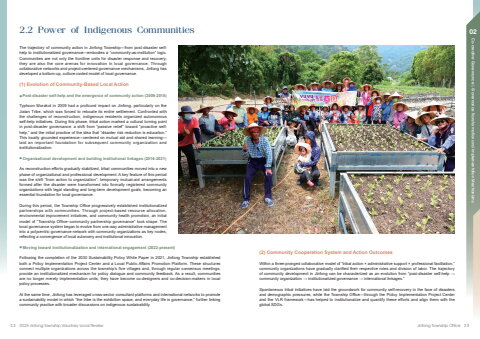
2 2 2025 Jinfong Township Voluntary Local Review Jinfong Township Office 23Co-creative Governance | Governance Transformation and Implementation Mechanisms2.2 Power of Indigenous Communities 02The trajectory of community action in Jinfong Township%u2014from post-disaster selfhelp to institutionalized governance%u2014embodies a %u201ccommunity-as-institution%u201d logic. Communities are not only the frontline units for disaster response and recovery; they are also the core arenas for innovation in local governance. Through collaborative networks and project-centered governance mechanisms, Jinfong has developed a bottom-up, culture-rooted model of local governance.(1) Evolution of Community-Based Local Action%u25c6Post-disaster self-help and the emergence of community action (2009-2015)Typhoon Morakot in 2009 had a profound impact on Jinfong, particularly on the Jialan Tribe, which was forced to relocate its entire settlement. Confronted with the challenges of reconstruction, indigenous residents organized autonomous self-help initiatives. During this phase, tribal action marked a cultural turning point in post-disaster governance: a shift from %u201cpassive relief%u201d toward %u201cproactive selfhelp,%u201d and the initial practice of the idea that %u201cdisaster risk reduction is education.%u201d This locally grounded experience%u2014centered on mutual aid and shared learning%u2014laid an important foundation for subsequent community organization and institutionalization.%u25c6 Organizational development and building institutional linkages (2016-2021)As reconstruction efforts gradually stabilized, tribal communities moved into a new phase of organizational and professional development. A key feature of this period was the shift %u201cfrom action to organization%u201d: temporary mutual-aid arrangements formed after the disaster were transformed into formally registered community organizations with legal standing and long-term development goals, becoming an essential foundation for local governance.During this period, the Township Office progressively established institutionalized partnerships with communities. Through project-based resource allocation, environmental improvement initiatives, and community health promotion, an initial model of %u201cTownship Office%u2013community partnership governance%u201d took shape. The local governance system began to evolve from one-way administrative management into a polycentric governance network with community organizations as key nodes, reflecting a convergence of local autonomy and institutional innovation.%u25c6 Moving toward institutionalization and international engagement (2022-present)Following the completion of the 2030 Sustainability Policy White Paper in 2021, Jinfong Township established both a Policy Implementation Project Center and a Local Public Affairs Promotion Platform. These structures connect multiple organizations across the township%u2019s five villages and, through regular consensus meetings, provide an institutionalized mechanism for policy dialogue and community feedback. As a result, communities are no longer merely implementation units; they have become co-designers and co-decision-makers in local policy processes.At the same time, Jinfong has leveraged cross-sector consultant platforms and international networks to promote a sustainability model in which %u201cthe tribe is the exhibition space, and everyday life is governance,%u201d further linking community practice with broader discussions on indigenous sustainability.(2) Community Cooperation System and Action OutcomesWithin a three-pronged collaborative model of %u201ctribal action %u00d7 administrative support %u00d7 professional facilitation,%u201d community organizations have gradually clarified their respective roles and division of labor. The trajectory of community development in Jinfong can be characterized as an evolution from %u201cpost-disaster self-help %u2192 community organization %u2192 institutionalized governance %u2192 international linkages.%u201dSpontaneous tribal initiatives have laid the groundwork for community self-recovery in the face of disasters and demographic pressures, while the Township Office%u2014through the Policy Implementation Project Center and the VLR framework%u2014has helped to institutionalize and quantify these efforts and align them with the global SDGs.


